


You Don't Need Salesforce. You Need Something That Fits.
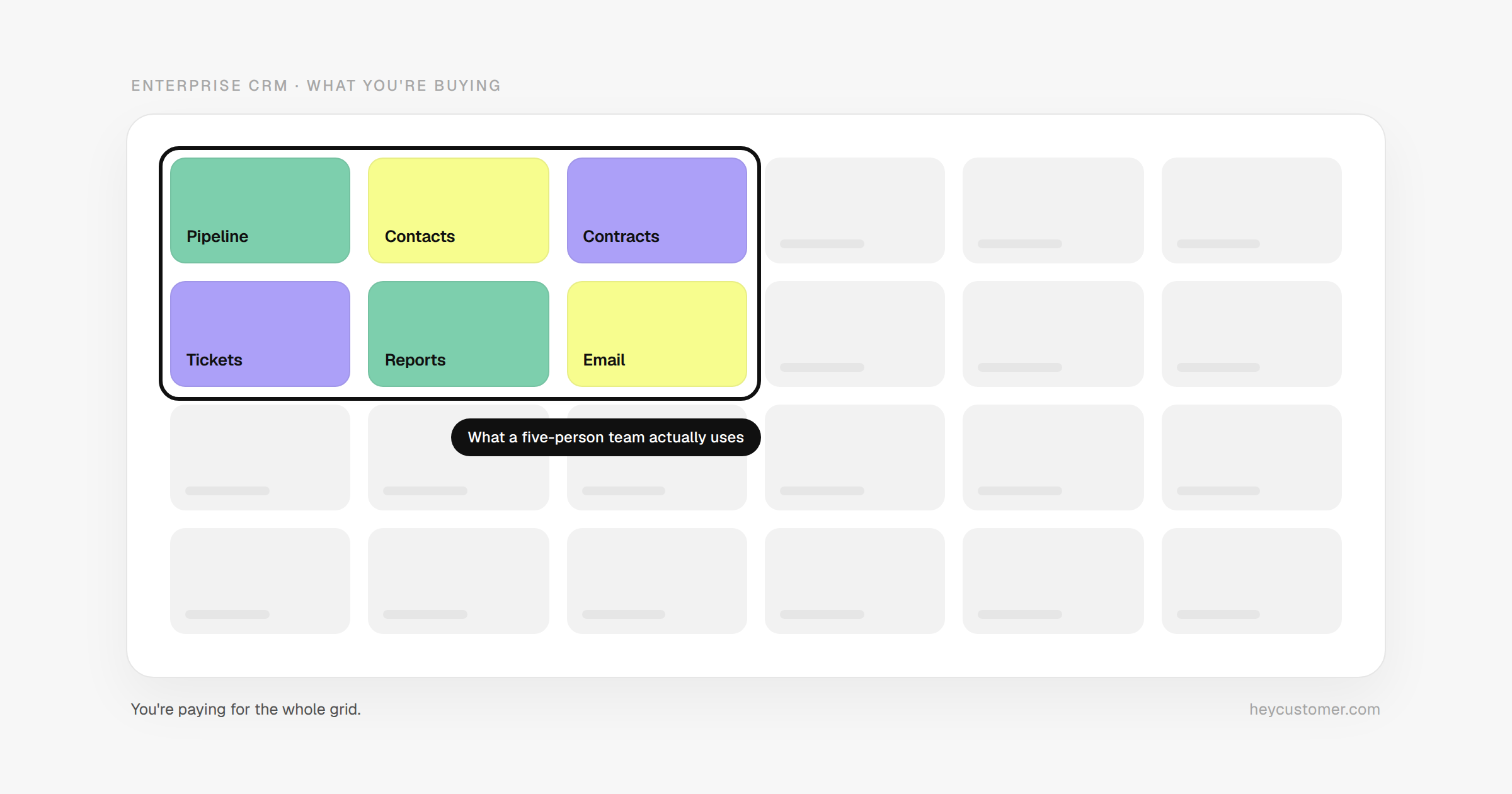
There's an assumption buried in a lot of software shopping: bigger is better. If a tool is good enough for enterprise companies, it must be the smart choice for everyone else too — you're just buying the junior version of the same good thing.
We believed that for a while. We ran our own small business for over twenty years, and we bought the big platform more than once because it felt like the responsible, grown-up decision. It cost us money, weeks of setup, and a fair amount of goodwill from a team that only wanted to log a call and move on.
Enterprise tools are built for enterprise problems
Salesforce and HubSpot are genuinely powerful platforms — for the companies they were built for. Sprawling org charts. Departments that each need their own workflows. Compliance requirements that justify a dedicated admin. A marketing team running six campaigns at once that all need to be attributed, segmented, and scored. If that's your business, the complexity is earned. Those tools are solving problems you actually have.
Most small businesses aren't solving that problem. A five-person team tracking leads, closing deals, and keeping customers happy doesn't need a platform designed to coordinate a thousand-person sales org. They need something that does the job without asking them to become a systems administrator first.
The hidden cost of more
The pitch for big platforms is always more: more features, more customization, more integrations, more room to grow. What the pitch leaves out is what more costs a small team.
- More setup time. Enterprise CRMs routinely take weeks to configure — often with a paid implementation consultant — before anyone can use them for real work. HubSpot's Sales Hub Professional carries a mandatory $1,500 onboarding fee in year one. Salesforce implementations get quoted as their own projects.
- More complexity per seat. A rep who needs to log a call and move a deal forward shouldn't need training to find the right screen. Every extra module is one more thing your team has to learn around.
- More cost that doesn't map to value. Marketing automation, campaign attribution, and lead scoring are genuinely useful — if you have a marketing team running campaigns. If you don't, you're paying to keep infrastructure warm that nobody opens.
- More tiers and gates. This is the one that stings. Salesforce Sales Cloud runs about $25 per user per month for Starter Suite, $100 for Pro, and $175 for Enterprise, billed annually. Those jumps aren't arbitrary — they're where the features live. API access, for example, sits at the Enterprise tier; below it, it's a paid add-on. Every growth milestone turns into a repricing conversation.
None of this makes those platforms bad. It makes them mismatched — priced and shaped for a company ten times your size. We ran the full arithmetic on the classic small-business stack in what a five-person team really pays for HubSpot, DocuSign, and Zendesk, if you want the receipts.
Straightforward is a feature, not a compromise
There's a tendency to treat simplicity as something you settle for — the option you pick because you can't afford the real tool yet. That framing gets it backwards. For a lot of small businesses, a straightforward system isn't a lesser version of an enterprise CRM. It's the correct tool for the actual job.
A straightforward CRM means:
- Your team can use it on day one, without a training program
- You're not paying for marketing automation you'll never open
- Adding a new hire doesn't trigger a call with a sales rep
- The system matches how a small team actually works — one pipeline, one inbox, one clear view of the customer — instead of a dozen modules you have to stitch together yourself
When you genuinely should buy Salesforce
We'd rather be useful than persuasive, so here's the other side of it. Buy the big platform when:
- You have, or are about to hire, someone whose job includes administering the CRM
- Marketing is a real function at your company, with campaigns that need attribution and scoring
- You're in a regulated industry where granular permissions and audit trails aren't optional
- You need deep customization — custom objects, multi-step approval chains, territory management
- You're heading past fifty seats, with distinct teams that each need their own process
If two or more of those describe you, the complexity is buying you something real and you should pay for it. We'd genuinely rather you land somewhere that fits than switch to us and churn in four months.
You can still have everything you actually need
The real question was never big platform or nothing. It's whether you can get the core of what a CRM should do — track leads, manage a pipeline, handle contracts, support customers, see clear reporting — without paying for, configuring, and maintaining the parts built for someone else's company.
For most small businesses, the answer is yes. Pipeline management, e-signatures, support ticketing, and reporting aren't exotic enterprise features. They're the fundamentals. That's the whole bet behind Hey Customer: one plan at $10 per user per month with all of it included — no tiers, no add-ons, no per-document fees, no onboarding invoice. See exactly what's in it.
The takeaway
Bigger platforms aren't wrong. They're built for a different problem than the one most small businesses actually have. If your team doesn't need a marketing engine, a dedicated admin, or a six-week onboarding process, you're not settling by choosing something simpler. You're choosing the tool that fits the business you're running today — instead of paying, in money and time and complexity, for the business you might be someday.
Pricing figures are US list prices, verified August 2026 against vendors' published pricing pages. Salesforce reprices its editions regularly, so check the current numbers before you buy. Spot something out of date? Email hello@heycustomer.com and we'll fix it.