


What a 5-Person Team Really Pays for HubSpot + DocuSign + Zendesk
Let's get something out of the way first: HubSpot, DocuSign, and Zendesk are excellent products. We used versions of this exact stack during the twenty years we ran our own small business. HubSpot's CRM is polished, DocuSign practically invented trustworthy e-signatures, and Zendesk sets the standard for support ticketing. If we thought these tools were bad, we wouldn't have built Hey Customer — we built it because of what it costs, in money and in glue work, to run three of them at once.
So this isn't a takedown. It's an honest receipt. We priced the classic small-business stack for a five-person team, using each vendor's cheapest published annual plan — no add-ons, no premium tiers — so the comparison is as generous to the stack as we can make it. All prices are US list prices with annual billing, verified in August 2026 from the vendors' published pricing.
The scenario
Picture a typical five-person business — an agency, a contractor, a small distributor. Everyone touches customer records. Two people send contracts. Two people handle support. Here's what that team needs to buy:
- A CRM for all five people — HubSpot Sales Hub Starter at about $20 per user per month.
- E-signatures for the two people who send contracts — DocuSign Standard at about $25 per user per month.
- Support ticketing for the two people who answer customers — Zendesk Support Team at $19 per agent per month.
The math
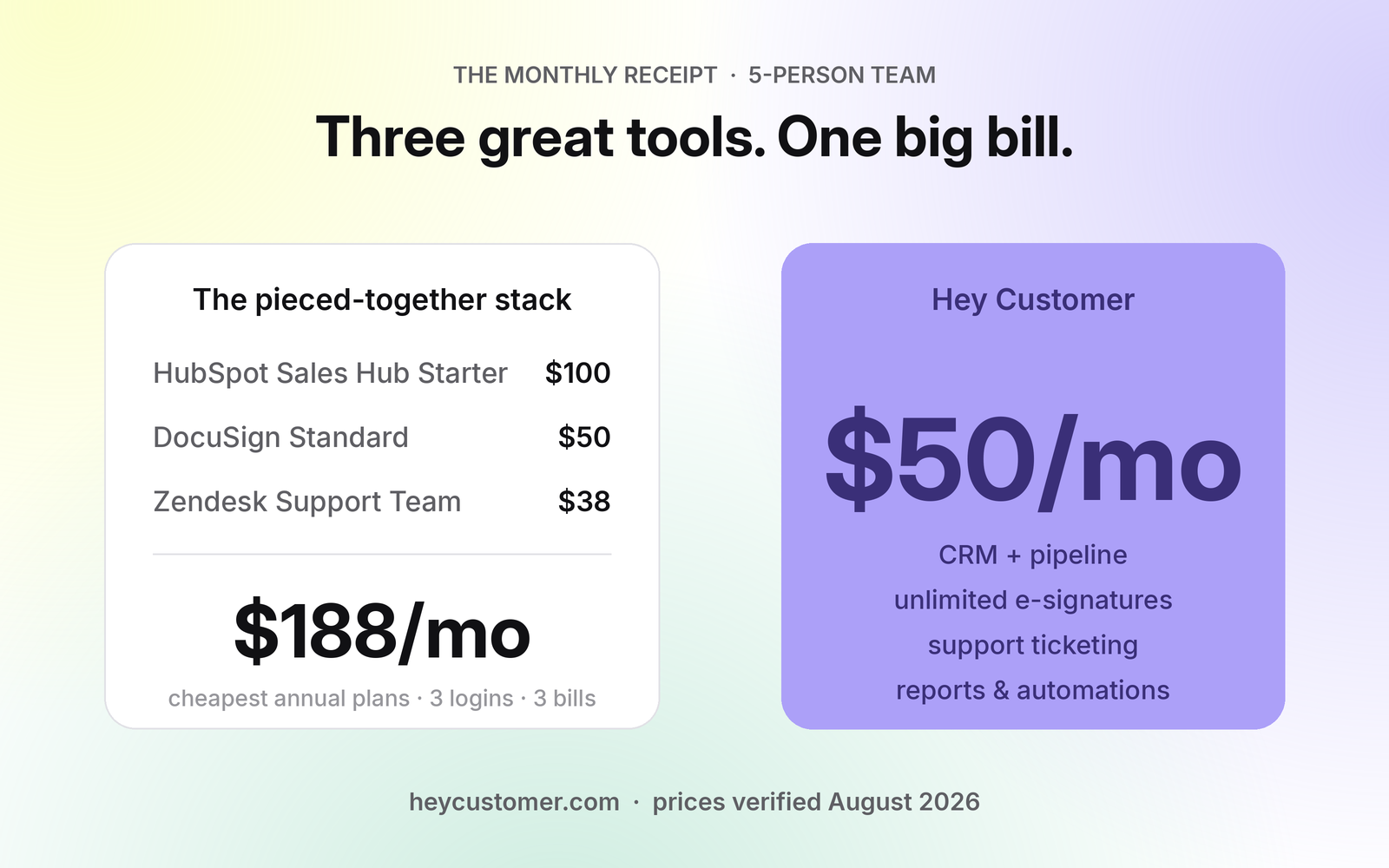
HubSpot Starter: 5 users × $20 = $100/month. DocuSign Standard: 2 users × $25 = $50/month. Zendesk Support Team: 2 agents × $19 = $38/month.
That's $188 per month, or about $2,256 per year, for the entry tier of everything — three logins, three bills, three places your customer data lives.
Hey Customer for the same five people: 5 × $10 = $50 per month, or $600 per year, with pipeline, unlimited e-signatures, support ticketing, reporting, email sync, and automations included for every user. Same team, same jobs to be done, about $1,650 a year back in your pocket.
The costs that don't show up on the pricing page
The sticker math actually understates the gap, because the stack has a few habits worth knowing about before you sign up:
- Envelope caps. DocuSign's Standard annual plan includes roughly 100 envelopes per user per year — about eight contracts a month each. Go over, and you're into overage fees or an upgrade conversation. If contracts are how you close business, you'll feel this cap in your busiest month, which is exactly the wrong time. Hey Customer's e-signatures are unlimited, because we think a good month shouldn't come with a penalty.
- The upgrade ladder. That $20 HubSpot Starter seat is a genuinely good deal — until you need the features that make a CRM sing for a growing team. Sales Hub Professional runs about $100 per seat per month and carries a mandatory $1,500 onboarding fee in year one. Five seats on Professional plus DocuSign plus a step up to Zendesk Suite Team ($55 per agent) lands north of $8,000 in the first year. None of that is a trick; it's just how good enterprise software is priced — for enterprises.
- The glue work. Three tools means three tabs, three exports, and one question — "what's the story with this customer?" — answered in three places. The contract lives in DocuSign, the deal lives in HubSpot, the complaint lives in Zendesk, and stitching them together is your job. Nobody invoices you for that time, but you pay for it every week.
What the stack does better — honestly
If we're asking for your trust on the math, you should hear the other side too. HubSpot's marketing tools go deeper than anything we make — if you run serious email campaigns and content operations, Marketing Hub is a real advantage. Zendesk's omnichannel support (live chat, voice, social) goes further than our built-in helpdesk. DocuSign's ecosystem of integrations and advanced verification is unmatched for regulated industries. If those specific depths are core to how you operate, buy them — you'll be in good hands, and you should pay for exactly that depth.
Our argument is narrower, and we think stronger for it: most small teams never use that depth. They use a pipeline, contacts, contracts, tickets, and a report on Monday morning. For that — the actual daily work of serving customers — paying three vendors $2,200+ a year and doing the glue work yourself is a lot to carry.
The bottom line
A five-person team runs about $2,256 a year on the cheapest version of the three-tool stack, with envelope caps and an upgrade ladder waiting. The same team runs $600 a year on Hey Customer, with everything included and one place where the whole customer story lives.
Great tools, genuinely. But if you're a small team, you deserve pricing that was designed for you — not a discount ramp into pricing that wasn't.
Prices are US list prices with annual billing, verified August 2026 from vendor pricing pages. If you spot something out of date, email us at hello@heycustomer.com and we'll fix it — keeping this honest matters more to us than winning the comparison.