


Why Opportunities Stall. And the Two Dates That Stop It.
We lost a deal once that we were certain we'd won. The proposal went out on a Tuesday, the customer said it looked good, and we moved on to the next fire. Three weeks later they signed with someone else. Nobody on our team dropped it, exactly. Nobody picked it back up either. When we went looking, the last entry on that opportunity was the proposal, and the next entry was the loss.
Opportunities stall when nobody owns the next step and nobody notices the silence. That's the miss. It isn't a lost argument or a bad price. It's a gap in the calendar that nothing was watching.
Deals rarely die with a no. They go quiet.
Ask a small team to list the opportunities they lost last quarter and most will have a reason for each one — budget, timing, a competitor. Ask for the last time anyone spoke to the customer before the loss, and the room gets thoughtful. In our experience the honest answer is usually "longer ago than we'd like," and the loss reason is the story we told ourselves afterward.
The pattern shows up in a few predictable ways:
- The proposal was the last touch. Sending it feels like a finish line, so nothing gets scheduled after it. The customer's silence reads as "thinking about it" right up until it reads as "went elsewhere."
- The next step lived in someone's head. "I'll call them after the holiday" is a plan. It just isn't a plan anyone else can see, cover, or ask about.
- The board looked fine. An opportunity in the Proposal column looks exactly the same on day 2 and day 32. Status tells you where a deal is. It tells you nothing about whether it's moving.
- Everyone was busy with what was loud. An inbox announces itself. A quiet customer doesn't. Busy teams work the loud things and lose the quiet ones.
None of this is a character flaw. It's what happens when momentum is a feeling instead of a number.
Momentum is a number: days since last contact
The fix starts with a definition. An opportunity has momentum when the customer has heard from you recently, and it loses momentum with every day that passes without contact. That's it. Not "we feel good about it." Not "they said it looked good." Days since the last real contact.
The definition only works if "contact" is strict:
- Contact is a conversation with the customer. An email sent or received, a call, a text, a meeting, an in-person visit. A signed document counts too — it's the clearest contact there is.
- Contact is not housekeeping. Moving a deal to a new status, changing the value, writing an internal note. Those are things you did to the record. The customer felt none of them.
- The clock resets on contact and nothing else. Which means the only way to turn a cold deal warm again is to talk to the customer.
Once momentum is a number, you can put a threshold on it. Two lines are enough: a green one (contacted this recently, the deal is alive) and a red one (longer than this, the deal has gone cold). Everything between is yellow — not lost, but losing. A week and a month are sensible defaults; a business that closes in three days wants tighter lines, and one that closes over a year wants looser ones. The exact numbers matter less than the fact that your whole team agrees on them, and that the red ones show up somewhere you'll see them on Monday morning.
Every open opportunity needs a next step with a date
Days since last contact tells you what already happened. It's a smoke detector. The other date is the one that prevents the fire: the next step, with an owner and a day.
The rule is simple to state and surprisingly hard to keep: no open opportunity leaves your screen without a next step. Sent the proposal? The next step is a call on Thursday. Had the call? The next step is a follow-up email Monday. Customer asked for two weeks? The next step is a check-in in two weeks. The step can be small. It can't be blank.
Done well, a next step has exactly three parts, and a to-do list on the wall gives you none of them in the right place:
One owner. Not "the team." A name. If that person is out, someone else can see the step and cover it, because it's attached to the opportunity rather than buried in a personal reminder app.
One date. A step without a date is a wish. A date turns it into one of four states — past due, due today, scheduled, or nothing planned — and only one of those is quiet. The other three are asking for something.
One place. The next step sits on the opportunity itself, where whoever opens the record sees it first. Completing it should log the contact — a done call is a call that happened — and reset the momentum clock in the same motion. Two dates, one action.
And the reminder should come to you. A step due today belongs in the owner's inbox that morning without anyone asking. If it's past due, it should say so, plainly, until it's done or moved to a real date — not snoozed into next week for the fourth time.
What Monday morning looks like
With both dates in place, the start of the week has an order to it.
Past due and due today first. These are commitments you already made. Work them before you touch anything new.
Going cold second. Open opportunities past your red line, biggest value first. Each one gets a real contact today or an honest decision that it's lost — either is better than another week of silence.
"No next step" is a status, not a blank. Pull up the open opportunities with nothing planned. Each one gets a step before lunch. If you can't think of one, that's information too.
Then, and only then, the board. A status-by-status review is where most teams start. It belongs at the end, once the deals that are asking for something have been answered.
When this isn't your problem
We'd rather be useful than sell you something, so here's the other side. If your sales cycle is one conversation — a quote and a yes at the counter — there's no gap for a deal to stall in, and a next-step habit is overhead. If your whole pipeline is a handful of opportunities you talk to every week, you already know which one has gone quiet; you don't need a number to tell you.
Two harder cases. First, the number is only as honest as the logging. A team that talks to customers and never records it will see a pipeline full of red that isn't real, and stop trusting it within a month. Fix the habit before you trust the color. Second, a next step is not a substitute for a reason to call. "Checking in" every three days to keep a dot green is momentum theater, and customers can tell. If you have nothing to bring — a question answered, a revised number, a useful introduction — the honest step might be further out, and that's fine. The date should be real. So should the reason.
The takeaway
Opportunities don't usually die of a no. They die of a gap that nobody was watching. Two dates close the gap: how long since the customer heard from you, and when they'll hear from you next. Make the first one a number your team agrees on, make the second one mandatory for every open deal, and the quiet ones stop being quiet.
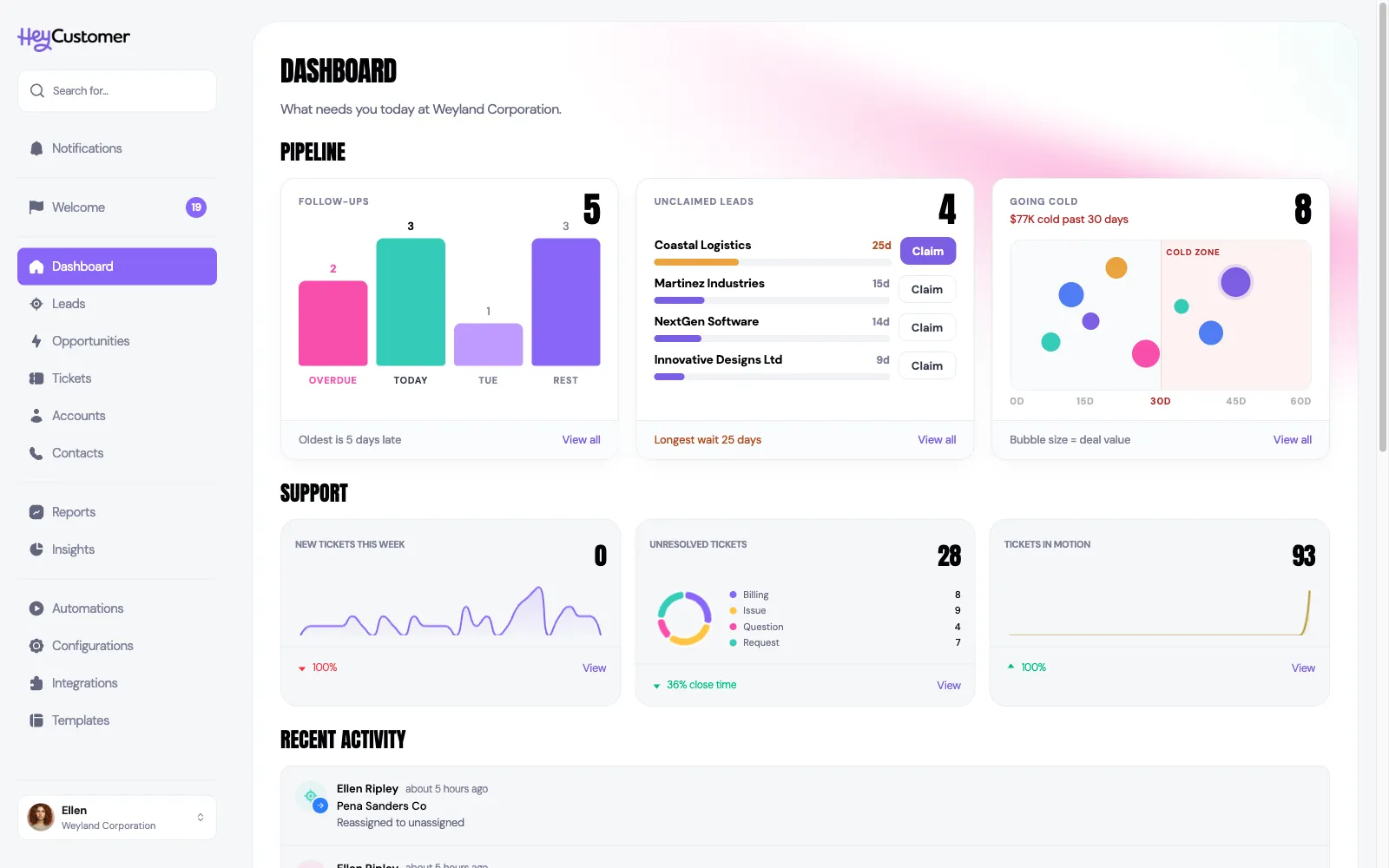
This is how the pipeline in Hey Customer works out of the box: every opportunity carries a momentum color from days since real contact, with the green and red lines set under Configurations, and a next step with an owner and a date that shows up in the dashboard's Follow-ups the day it's due and in the owner's inbox that morning. Completing the step logs the contact and resets the clock. It's $10 per user per month with everything included, and there's a 30-day free trial to run your own pipeline through it — see what's in every plan. If your Monday starts with a dashboard, we also wrote about why a dashboard should tell you what to do today, not what happened last week.