


Your Dashboard Isn't a Report. It's a Decision-Making Tool.
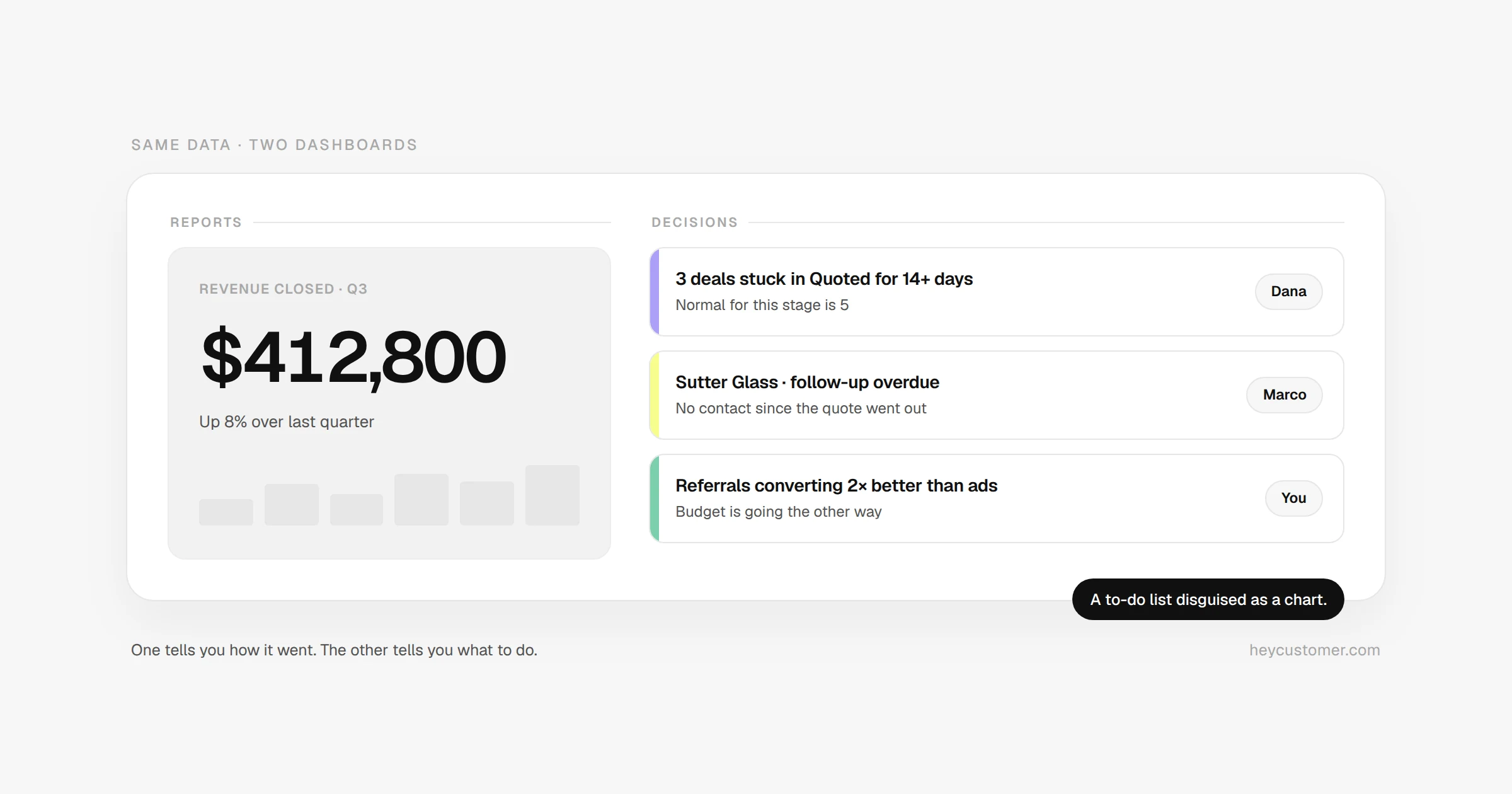
Most teams treat the CRM dashboard like a rearview mirror. Something to check on Friday, glance at before the Monday meeting, mostly there to confirm what everybody already suspected. We did this for years in our own business — we had a beautiful dashboard, we looked at it constantly, and it never once changed what we did that week.
That's the miss. A dashboard built well isn't a summary of what already happened. It's the thing that tells you what to do next.
The difference between reporting and deciding
The distinction is subtle and it matters enormously.
A reporting dashboard tells you total revenue closed this quarter. Useful, but passive — a number you look at and nod along to. Nothing about it implies an action.
A decision-making dashboard tells you which three deals have been stalling in the same stage for the same reason, which person on your team needs help this week, and which lead source is quietly outperforming the one you've been paying for. That's not a summary. It's a to-do list disguised as a chart.
The difference isn't the software. It's how it was set up, and who was in the room when someone decided what to put on it.
Where most dashboards go wrong
A few patterns show up constantly in dashboards that look impressive and help nobody:
- Too many metrics, no hierarchy. When everything is on the dashboard, nothing is. If someone has to hunt for the number that matters, they stop looking — usually within about two weeks.
- Vanity metrics over action metrics. Total leads captured feels good. Leads sitting in the same stage for 14+ days is the number that requires a human to do something today.
- Static snapshots instead of live views. A report that was accurate as of last Tuesday isn't much better than instinct by the time you're deciding on Thursday.
- No connection to ownership. "12 deals at risk" is only useful if it's immediately obvious whose deals they are. A number without a name attached is a number nobody acts on.
What a pipeline-optimized dashboard actually looks like
Fixing this usually comes down to four shifts.
Surface bottlenecks, not totals. Instead of "here's your pipeline value," show where deals get stuck: which stage, how long they've been there, and how that compares to your normal cycle. A pipeline that looks healthy in aggregate can be badly clogged in one stage, and the aggregate is exactly what hides it.
Make it live. Stages, deal movement, and ticket status pulled in real time mean the dashboard reflects what's true right now rather than what was true when the batch job last ran overnight.
Attach ownership automatically. Every stalled deal, at-risk account, and overdue follow-up should carry an obvious owner — not a list someone has to cross-reference against a separate sheet to figure out who's up.
Build around the decision, not the department. A sales lead and a support lead need different views of the same underlying customer data, because they're deciding different things. One generic dashboard that everyone is expected to interpret differently is how you end up with a dashboard nobody trusts.
The compounding value of a view that shows up on its own
Here's the quieter benefit. When a dashboard is reliable and it arrives without being asked — in someone's inbox at 8am Monday, say — it stops being a thing people have to remember to check. It becomes part of how decisions already get made.
That's the actual goal. Not a dashboard your team can look at. One that shows up at the moment a decision needs making, carrying exactly what's needed to make it.
When a dashboard isn't your problem
We'd rather be useful than sell you something, so here's the honest limit. A dashboard can't fix a process that doesn't exist. If deals aren't being logged consistently, or your stages mean different things to different people, a better dashboard will just report the confusion faster and with nicer typography. Fix the definitions first — what each stage means, when a deal moves, who owns what — and the dashboard becomes worth building. Do it in the other order and you'll get a very polished picture of nothing.
Same goes for size. If your whole pipeline is twelve deals you can hold in your head, you don't need a dashboard. You need it when you can no longer tell, without looking, which deal has gone quiet.
The takeaway
A good dashboard doesn't just tell your team how the quarter is going. It tells them where to put today — which deal needs a nudge, who needs backup, which lead source deserves more budget. Treat it as a decision engine rather than a scoreboard, and the pipeline stops being something you review and starts being something you steer.
Reporting is included in every Hey Customer plan, not gated behind a higher tier — build the view around the decision you're actually making, and have it land in your inbox before you need it. If you're earlier in this than dashboards, we also wrote about why the case for a CRM is stronger for small teams than large ones.