


Why a CRM Isn't Optional Once You're Serious About Growing
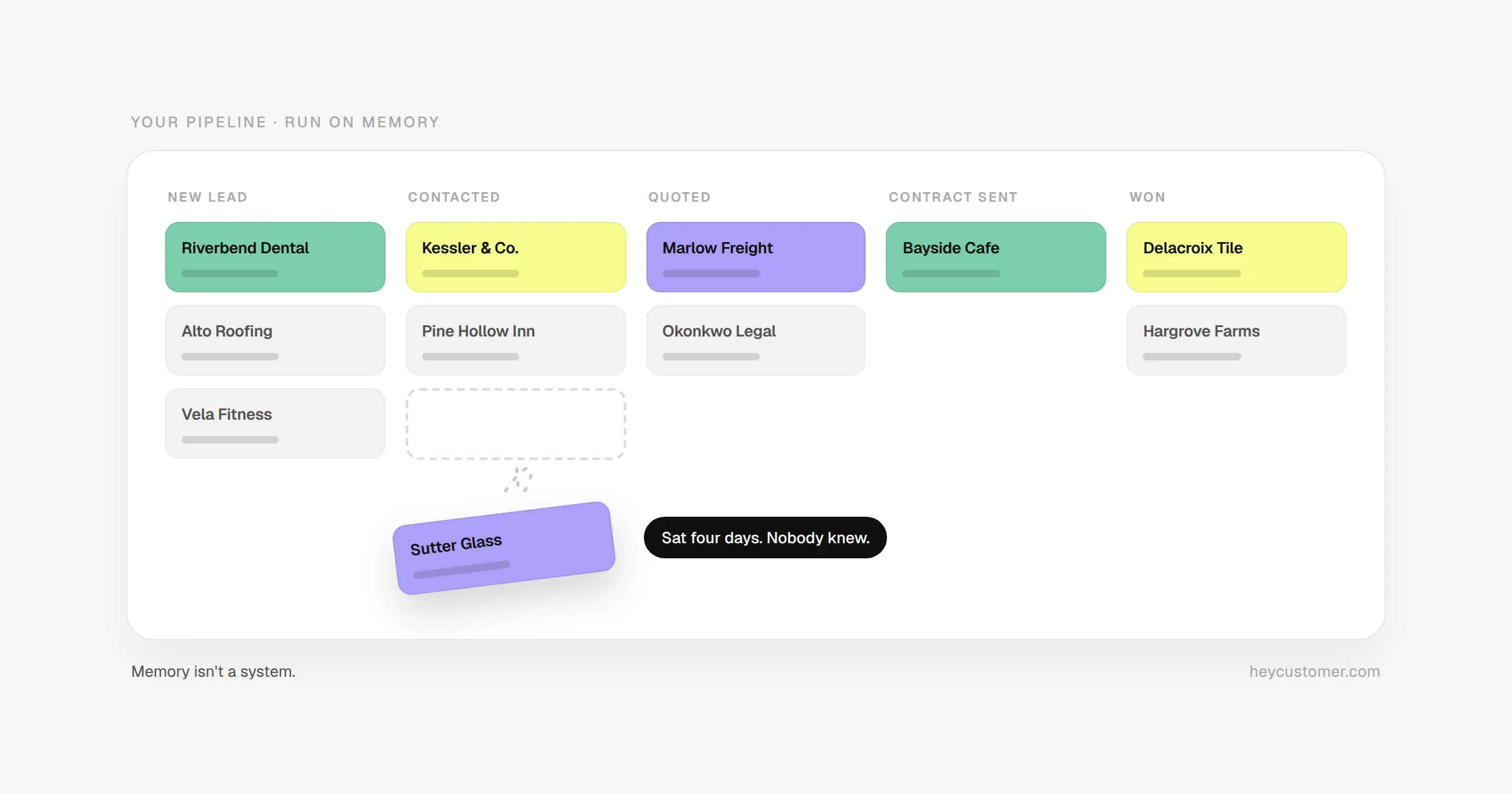
There's a moment almost every small business hits. The spreadsheet that used to track leads has too many tabs. Someone asks "did we ever follow up with that customer?" and nobody's sure. A deal falls through — not because the product was wrong, but because nobody remembered to send the contract.
None of those is a big failure on its own. Together, they're the sound of a business that has outgrown its systems. We ran our own small business for over twenty years, and the thing we'd tell you is that the moment never announces itself. Nothing crashes. You just quietly start losing things you used to catch.
Growth breaks informal systems before you notice
Early on, informal works fine. The founder knows every customer by name. A shared inbox and a notebook are genuinely enough. That holds right up until it doesn't — and the failure is never dramatic. It looks like this:
- A lead sits unanswered for four days because it got buried under everything else in the inbox.
- Two people follow up with the same customer, because neither knew the other already had.
- A renewal gets missed entirely, because it lived in one person's memory and that person was out sick that week.
None of that is a sign of a bad team. It's the sign of a team using memory and goodwill to do a job that now needs a system. Growth is exactly what exposes it: the approach that worked at twenty customers starts failing at two hundred, and it fails quietly enough that you find out from the customer.
Efficiency isn't only about saving time
It's tempting to think of a CRM as a time-saver — less manual data entry, fewer reminders to write yourself. That's real, and it undersells what's actually happening. The bigger gain is decision quality.
Without a system, a small business makes decisions on incomplete information: gut feel about which leads are worth chasing, guesswork about which deals are stalling, no real way to know whether the customer who churned last month showed warning signs first. With one, the same team is working from what actually happened — where deals stall, which lead sources convert, which weeks the follow-ups slip. Same people, same hours, meaningfully better calls.
That's the honest efficiency story. Not doing more things faster. Doing fewer useless ones.
Growth without a system doesn't scale — it just gets chaotic
There's a difference between growth and growth you can keep. A business can add revenue for a long while on hustle alone: more calls, longer hours, sheer effort from two or three people who care a lot. What hustle can't do is scale, because it depends on those specific people continuing to hold the whole business in their heads.
A CRM is what turns that into a repeatable process. A new hire ramps by working the same pipeline stages as everyone else, instead of shadowing your best person for three months to absorb tribal knowledge. A deal moving forward stops depending on someone remembering, and starts depending on something surfacing it. That's the actual unlock for a small team — not doing more, but building something that doesn't require everyone to be perfect every day.
Your customers feel it too
This isn't only an internal story. Customers notice, even though they'd never name the cause. A business with a system remembers what was discussed last time. It doesn't ask the same question twice. Sales and support aren't working from two different pictures of the same person. The customer never learns a CRM exists — they just come away thinking this company has it together, which is most of what repeat business is made of.
Why this matters more for small teams, not less
The common assumption is that CRMs are for big companies with big sales teams. We'd argue it's closer to the opposite. A large enterprise has redundancy: several people who might catch a dropped ball, an ops team, layers of process that exist precisely to make individual mistakes survivable. A five-person business has none of that. When a lead gets dropped, nothing catches it.
Thinner margin for error means the cost of a memory-based system is higher for a small business than a large one, not lower. Small teams are the ones who can least afford to lose things, and most often the ones running without a net.
When you don't need one yet
We'd rather be useful than sell you something, so here's the other side. You probably don't need a CRM if you're solo with a dozen customers you speak to every week, or if your business is a single transaction at a counter with no follow-up, or if your whole pipeline genuinely fits on one screen and nothing has ever slipped through. A spreadsheet is a fine tool. Plenty of good businesses run on one for years.
The tell that you've crossed over is simple: if you've asked "did anyone follow up with them?" more than once this month, and the answer took real effort to find, the spreadsheet has stopped being a system and started being a place where things go missing.
The takeaway
A CRM isn't about looking official or checking a box on the way to being a real company. It's the infrastructure that lets a small team make better decisions, stop dropping the things that only memory was holding, and grow without every new customer adding proportional chaos. It isn't the reward for growing. It's one of the things that makes the growth survivable.
That's what we built Hey Customer to be — pipeline, contacts, contracts, tickets, and reporting in one place, at $10 per user per month with everything included, and a 30-day free trial so you can find out on your own data whether it holds. And if you're weighing it against the bigger platforms, we wrote about why fit matters more than size too.